

How Parker Staffing Turned a New Specialty Into Repeat Client Orders With Alex
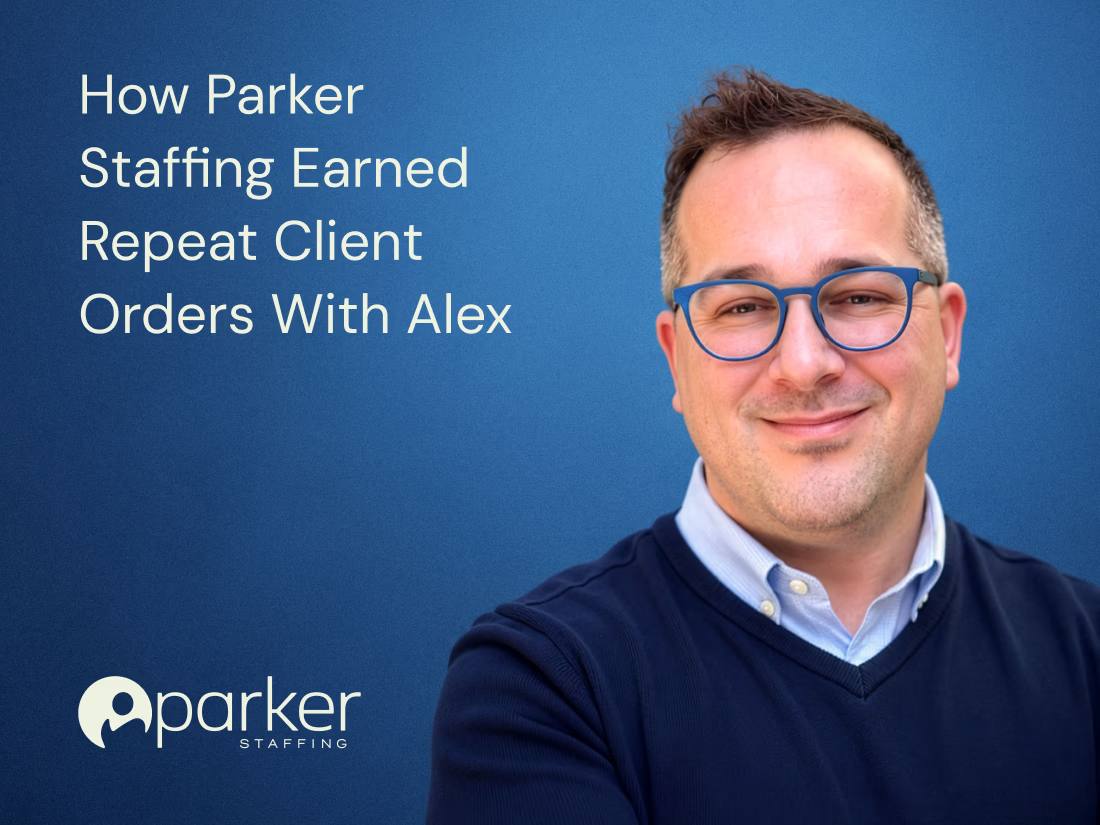
Parker Staffing has placed administrative, HR, and customer service talent since 1978. Cory Lam, VP of Operations and Technology, brought on Alex to reach candidates on their own timeline and give his recruiters more reach than human hours allow. Just three months after launch, Parker achieved a 22% boost in candidate connections and expanded into a new recruiting specialty, winning over a new client who returned with repeat business.
At a Glance
- 22% more candidate connections in three months
- 30 to 40% of candidates interview outside of business hours
- 1 new specialty, 1 new client, more orders: a first sonographer placement that turned into repeat business
The Customer
Parker Staffing is a Seattle-based staffing firm that has served the Pacific Northwest since 1978. Parker places contract and direct hire talent in non-clinical roles with a focus on administrative, human resources, and customer service positions. They have recruiters working across every U.S. time zone.
Cory Lam has spent 15 years at Parker and now serves as VP of operations and technology. He owns the firm's recruiting technology and tracks its pipeline benchmarks from application through interview. Cory shared, "Parker and I myself have a longstanding history of embracing technology and trying to find different ways to innovate and be on the early side of industry disruptors."
The Challenge
Like many staffing firms, the team was juggling tight deadlines, limited expertise in new specialties, and recruiters stretched across too many reqs. Alex took on the time-consuming front end of the process, so recruiters could focus on engaging top candidates and closing placements, "Recruiters don't love administrivia, they love the human part of it."
Limited recruiter availability
By Cory's count, 30 to 40% of Parker's candidates need to talk outside normal business hours: on a lunch break, after five, on weekends, or around school if they are new graduates. Even with recruiters in every U.S. time zone, meeting those windows meant either losing the candidate or eating into the team's own work-life balance.
Follow-up depended on human memory
Recruiters sent one outreach and relied on remembering to follow up, so most candidates dropped off after the first few days. Recruiters naturally moved on to whoever responded fastest, and good candidates slipped away simply because nobody got back to them in time.
Six years of AI tools that couldn't hold a conversation
Parker had experimented with AI-powered recruiting for about six years. The early tools were formulaic and robotic, and when a candidate asked a simple question about location, schedule, or pay, the answer was usually a deflection to the recruiter, repeated until the candidate gave up. Cory thought there had to be a better way, "I asked myself, 'How could I speed up the engagement with a candidate so that I didn't lose them, while improving the performance of our internal recruiting team so that they could speak to more people at once?'"
The Solution
Parker brought Alex in to handle the early steps of the process around the clock, so recruiters spend their business hours with candidates who are already engaged and informed.
A 24-hour first step, handed to recruiters by morning
Alex reaches candidates whenever they are available and keeps them moving with automated follow-ups across email, SMS, and phone. Candidates complete the early steps on their own schedule, and a recruiter reviews them and picks up the conversation during normal business hours.
Conversations that don't sound like a machine
What set Alex apart from the tools Parker had tried before was how it talks with candidates. Alex answers the simple questions about location, schedule, and pay from the job description instead of deflecting them, and in Cory's words, it "gives a little bit more of an anthropomorphized vocal approach to candidates that helps them engage and open up a little bit better."
Built-in expertise for roles the team is new to
When Parker takes on a role outside its usual mix, Alex draws on the job description and the client profile to build the questions that determine whether a candidate will succeed. That gives a junior recruiter, or a recruiter stepping into an unfamiliar specialty, a strong starting point from the first interview. Cory has also seen interview quality keep improving as Alex learns the hard and soft skills that recurring roles require, sometimes covering requirements the original job description left out. "If you're used to recruiting medical assistants, you're probably not going to know the right questions to recruit a registered nurse or someone in oncology, or histotech. But the AI can leverage both the job description and the client profile in order to develop key questions that would be needed to determine if a candidate is going to be successful or not."
The Results
Parker started interviewing with Alex in July 2026, and three months in, the gains show up in engagement, conversion, and a new client relationship.
More candidates responding and staying in the process
Cory benchmarks applications against first-round interviews and recruiter interviews. Over the last three months, Parker's connections, meaning candidates who responded and engaged, rose 22%. He credits Alex's automated multi-channel follow-ups for keeping candidates in play past the first few days, when single human outreach used to drop off. Conversion from the Alex interview to the recruiter interview has also started to climb.
Flexibility for candidates without costing recruiters their evenings
Between 30 and 40% of Parker's candidates interview outside of business hours, giving Parker a way to say yes to those windows without asking its own staff to work them. Recruiters review completed interviews and engage during normal business hours, and the early housekeeping, like questions about location, schedule, and pay, is already handled by the time they pick up the conversation.
A first placement in a new specialty, and more orders behind it
Early in the rollout, Parker took on sonographer roles for a brand-new client, a specialty the team had not recruited for before. Using the questions Alex built from the job description and client profile, Parker placed its first sonographer with that client, and the client came back with more orders.
"We were able to not only hire that sonographer on, and that was a good win with a brand new client, but also bred more orders with that client because we had a slam dunk."
For Cory, that is the larger lesson: Alex can prop up a recruiting team moving into a new demographic or a new hiring level where it lacks specialist expertise.
What's Next
Cory sees Alex as part of a shift the whole staffing industry will have to make. Alex is the way Parker Staffing clears administrivia, so recruiters can have deeper behavioral conversations that lead to better matches and better hires.
"We're all going to have to continue to learn how to leverage artificial intelligence in a meaningful way that still inspires a human connection. That's one of the big takeaways I receive from us using Alex, is that we're still maintaining a human connection."
Our latest posts
The latest news, interviews, and resources.



Stay ahead of the crowd
Subscribe to our official company blog to get notified of exciting features, new products, and other recruiting news ahead of everyone else.