

Candidate Experience 2.0 with Mitchell Martin
Many case studies about AI and recruiting tend to open the same way: a company was drowning in candidates, then it got faster. Mitchell Martin has that story too: two AI recruiting tools piloted before Alex, both performing exactly as advertised. Neither was the answer.
Speed was never Mitchell Martin's problem. The problem was that speed alone still left most of a five-million-person database unread: real, qualified people who applied and were never reached because there weren't enough hours in the day to reach them.
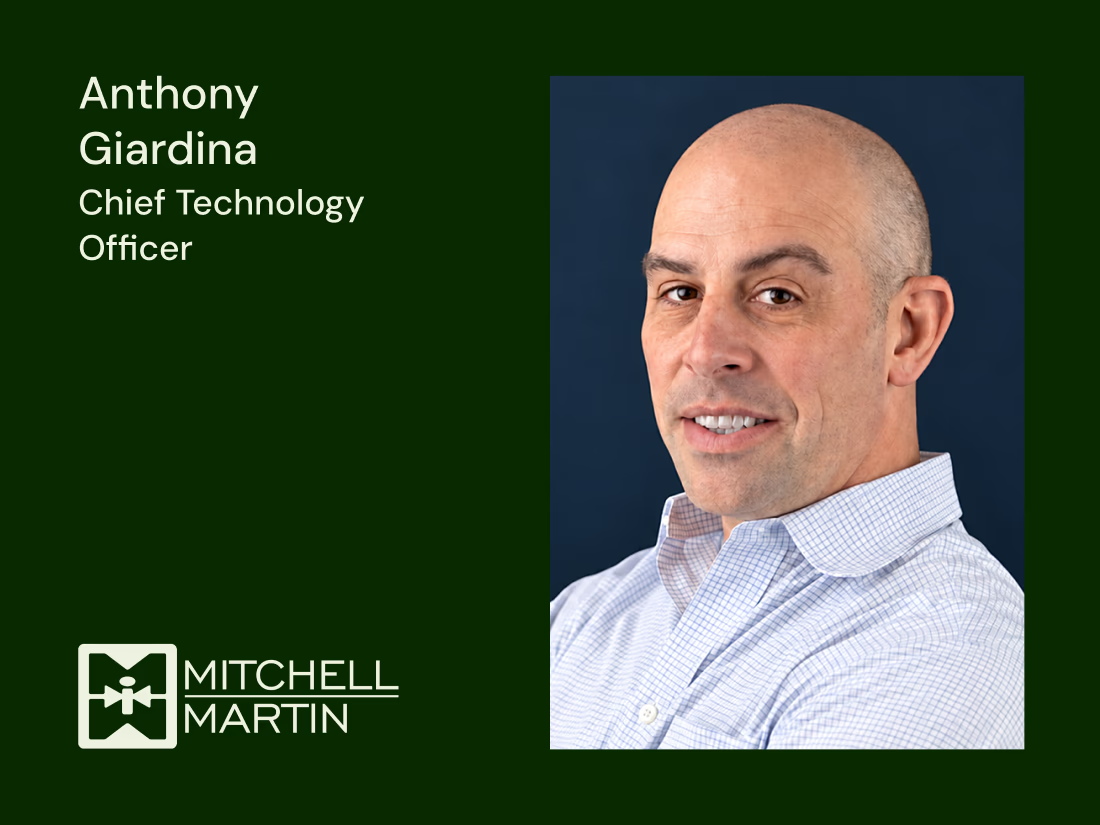
Anthony Giardina, Chief Technology Officer at Mitchell Martin, a 40-year-old IT and healthcare staffing firm, had already piloted two AI interviewing tools before Alex. What he wanted wasn't just a faster interview. It was a way to make sure that when a thousand people apply to a single job overnight, none of them disappear into the pile.
If you've got the yearning to see how AI is really going to impact the recruiting business, I don't think there's a better partner out there.
- Anthony Giardina
At a Glance
- 5x more candidates given a real conversation each month (~700 to 3,500+ interviews in four months).
- 1 from 2021. A candidate buried in the database for five years, reengaged and now working at a client.
- 56 candidates submitted to clients from Alex interviews, with 6 already started.
- 1 of 3. Three strong tools evaluated. One could handle a 40-year-old firm's full range of roles.
- 0 new systems for recruiters to learn. Alex runs inside the team's existing JobDiva ATS.
The Customer
Mitchell Martin is a 40-year-old IT staffing firm headquartered in New York, with roots on Wall Street and in financial services and a fast-growing healthcare practice as its second vertical. Employee-owned through an ESOP and ranked among the top 50 staffing firms in the country, it runs between roughly 50 and 100 recruiters globally as the market moves.
Those recruiters work at real scale: close to 5 million candidates in the database, roughly 300,000 applicants a year, and each recruiter managing relationships with 20 to 30 active people at once. Anthony Giardina, the firm's Chief Technology Officer, owns the recruiting technology and, just as much, how recruiters actually use it. "My role here goes beyond just the selection or implementation of technology. I'm really highly involved in the operation and how that technology is used and adopted and infused into the business process of our sales and recruiting professionals."
The Problem
Post a job online and a thousand people can apply overnight. For the recruiter on the other end, that isn't abundance, it's a pile no human being can actually finish reading, "When you post a job online and a thousand people apply to it overnight, how overwhelming it can be to try to pick out the people you actually have enough time to talk to. By and large, without Alex, you don't have the capacity to deal with it."
That capacity problem points to something simpler underneath it: the need to connect with the candidates who apply, and the drive to help them find the work they're actually seeking, not just the few a recruiter happened to have hours for. "We should be talking to people about relevant experience they match to. They should all be getting responses, " shared Anthony.
Mitchell Martin does not wait to be sold on new technology, and that instinct had already led it to pilot two AI recruiting tools before Alex. Both were genuinely capable, and both are a strong fit for high-volume, fixed-question hiring. As Anthony noted, "We saw that evolution of single-channel, single-purpose, rote line of questioning in the original tools we tested out, which was just cool in and of itself, but it just wasn't good enough."
Mitchell Martin's world simply asks for more range: traditional IT roles alongside emerging AI positions, entry-level to senior pay grades, a growing healthcare practice, and a 40-year ESOP story worth telling in every conversation. What the firm needed wasn't a faster rote question, it was something dynamic enough to carry all of it, and thorough enough that nobody who applied went unheard.
The Shift
Mitchell Martin moved the first pass of the funnel onto Alex, which now reviews inbound applicants, reopens the database for people already sitting in it, and runs the first conversation via text or phone, while recruiters keep every judgment call. The database problem is the one that stuck with Anthony most, "We're coming up on 5 million people in our database, and that's a lot of people for 50 recruiters or so to keep in touch with. There's plenty of people we've touched over the years who are probably a perfect fit for the next job coming down the pipe, but they're not always readily found. We're hoping Alex is going to help us uncover the diamonds we uncovered previously and forgot about, and bring them back up to the surface."
He's blunter about what that gap had cost the industry as a whole, "Search and match has been the bane of the staffing industry since its inception."
There's a financial logic sitting right underneath the human one. Mitchell Martin spends heavily on job boards, both to post new openings and to keep growing a database that mostly goes unused once someone's been added to it. But Anthony doesn't think it has to be that way,"We spend a lot of money on job boards, both posting jobs to get applicants in and harvesting candidates into a database of about 5 million people. We might as well reuse them."
What made this attempt different from the two before it was not a single feature. It was a partner whose pace matched the firm's own, "The dynamism that we saw, that's really the key. We're looking to find a partner that will continually try to push those limits, and during the pilot we saw that you guys were ready to do that. The things we thought we needed to pick off next, you already built or were picking off next too."
The internal skeptics came around fast, in part because Alex did not sound like the automated tools they expected. Anthony shared, "I put a very simple blurb in there about being a 40-year-old IT staffing company with an ESOP, and we were surprised at how effortlessly it just incorporated that into every conversation. You automatically think an automated interview is going to be pretty rote. It's just not the case anymore."
The Outcome
In under six months, Alex moved the firm's center of gravity from searching to talking to pre-qualified people. Alex has interviewed roughly 11,400 candidates, monthly interviews climbed from about 700 to more than 3,500 in July, and those conversations are converting: 56 candidates submitted to clients, 6 already started, and more in late stages.
The clearest proof of what "uncovering diamonds" actually looks like came down to a single record,"Alex reengaged somebody we had in our database from 2021 who may not have been found. Now they're one of the six working actively at our client."
Five years earlier, that person had been exactly who this story is about: not unqualified, not unplaceable, just unreached.
For Mitchell Martin's most tenured recruiters, the shift also brought back something the industry had quietly lost along the way, "What resonated with our most tenured people was this reorientation toward speaking with pre-qualified candidates, the way it used to work. They'd come in each morning to a page of people who had reached out and expressed interest, and it felt like gold, because they knew these people were interested and couldn't wait to get on the phone with them. The industry has gotten away from this in a digital world, when everything went transactional. This is really allowing us to take that high volume of activity and get it back down to the hot sheet you're calling from, building a relationship with the person."
It's better for the people doing the work, too, not only for the people finally getting a callback.
We're going to make their jobs better, because they're all in this job because they like to talk to people and help them get jobs. Finding them is one part of it. Actually getting them there, and celebrating when they get the job, should happen more often. That's a lot more rewarding, and not just monetarily.
- Anthony Giardina
The Proof
| Metric | Before Alex | With Alex |
|---|---|---|
| Candidates actually reachable in a given month | Whoever recruiters had hours for | 3,500+ real conversations a month (July), up from ~700 |
| The database's dormant candidates | Rarely revisited, for lack of time | Actively reengaged, including a 2021 record now placed with a client |
| AI recruiting tool that fit the business | 3 tested | 1 stuck |
| Candidates submitted to clients from AI interviews | Not tracked via AI | 56 submitted, 6 started |
| Recruiter focus | Search-heavy, transactional | Shifting to the submittal and the relationship |
What's Next
For Anthony, the real pull of the partnership is its pace: the sense of building alongside a leader rather than waiting on one. His focus is shifting from implementing to a happier challenge, the change management of helping recruiters make the most of a database that, for the first time, is actually being read in full. "You're taking cutting-edge technology, you're making it safe to use, and you're wrapping the right customer success team around it to help you move and change and evolve. That's about all you can ask for at this point in the game."
The Question Worth Asking
Every conversation about AI in recruiting still asks some version of the same question: can it screen faster than a person? Mitchell Martin already knew the answer to that, twice, before Alex ever came along. Neither answer moved the number that actually mattered.
The number that moved was how many of the five million people already in reach got a real look. Somewhere in that database was someone exactly like the 2021 record: qualified, findable, five years from being forgotten entirely. The real question was never how fast the funnel moves. It's how many people were sitting in it the whole time, waiting to be seen.
Our latest posts
The latest news, interviews, and resources.





Stay ahead of the crowd
Subscribe to our official company blog to get notified of exciting features, new products, and other recruiting news ahead of everyone else.