

How Akraya Scaled Technical Screening to 30,000 Interviews with Alex
The Customer
Akraya is a Bay Area-based IT staffing and MSP partner that has spent 25 years helping large technology companies hire highly technical talent.
Its recruiting operation is built for both scale and technical depth. The company has roughly 65–70 recruiters, supported by delivery managers, customer success specialists, and employee relations teams. In total, Akraya has about 150 internal employees and more than 600 consultants working on client projects.
The company is fully remote, with a large delivery hub in Pune, India.
Sagar Nair, VP of Delivery & India Operations, has led Akraya’s India delivery organization for more than eight years. He joined in 2018 as Country Head and Director of Recruiting and helped build the team that supports Akraya’s US business development and account management organizations.
Under his leadership, Akraya expanded from a primarily direct staffing model into MSP work and went on to win Supplier of the Year multiple times with two major MSP partners.
Technical knowledge is a big part of how Akraya recruits. Roughly 75–80% of Akraya’s recruiters trained as engineers before moving into recruiting.
The Challenge
Manual technical interviews were becoming a bottleneck, and Akraya needed to scale technical screening without lowering the bar. Even with a technically strong recruiting team, the pace of change in technology was becoming difficult to keep up with.
Recruiters understood the fundamentals, but they could not be expected to know every new framework, product, platform, or production environment that appeared in a job description.
That became a problem during candidate screening, “A lot of times you’re not able to cross-question and counter responses from a candidate because you don’t know everything about what the candidate is saying.”
Akraya also had a strict quality bar: before any candidate was submitted to a client, a delivery manager personally interviewed them to validate their technical skills.
That protected quality, but it also limited how many candidates the team could evaluate.
A 30-minute technical screen takes real time, and there are only so many a delivery manager can run in one day,“If a recruiter has to talk to every person for 30 minutes, how many calls can they do? Max, five, six in a day?”
As hiring volume grew, Akraya needed a way to increase screening capacity without lowering the quality of the evaluation or adding delivery managers at the same pace.
The Solution
Akraya evaluated Alex AI alongside other AI interview tools in 2024.
Two things stood out:
First, the product performed well in the initial demo. It understood technical context, followed candidate responses, and handled the conversation naturally.
Second, the Alex team was willing to listen and improve the product based on Akraya’s feedback.
“Alex AI was very eager to take our feedback and implement it... the product was actually very good. It understood the context, it responded correctly. It was smooth.”
Sagar Nair
But Akraya knew choosing the technology was only part of the job. The bigger challenge was getting the team comfortable using it.
The rollout focused on adoption, not just implementation
Delivery managers had built part of their professional identity around running technical interviews themselves.
Introducing AI into that process could easily have been seen as taking work away from them.
So Akraya treated the rollout as a change-management effort rather than simply installing a new tool.
For a fully remote company, it made a significant investment: delivery managers, team leads, and key recruiters were brought to Pune for a full week of in-person onboarding.
The goal was to work through how Alex would fit into the recruiting workflow, answer questions directly, and make it clear that the technology was there to expand the team’s capacity rather than replace people. Sales and account management were brought into the process as well.
Sagar described that week as critical,“In that one week, we made sure that we ironed out all the questions that people had about its usage, how it would become a part of the workflow, how we weren’t thinking of taking away anyone’s job... Otherwise this would have been very difficult. It would have been a failure.”
Alex’s structured interview reports gave those teams something concrete to show clients: evidence that candidates had already gone through a deeper technical evaluation before reaching the hiring manager.
That helped turn the screening process itself into part of Akraya’s value proposition.
The Results: 30,000 interviews and 15,000 hours of screening time saved
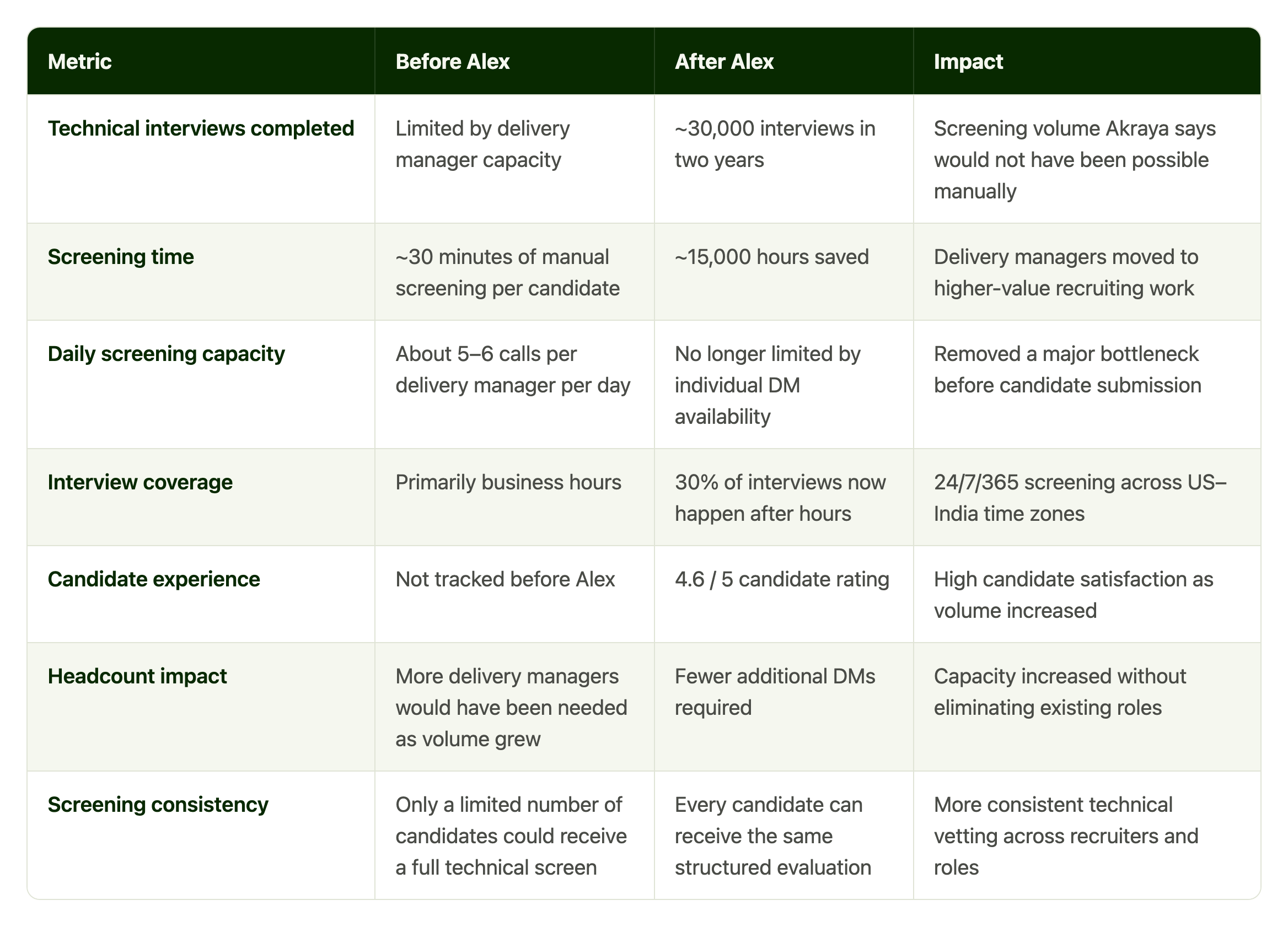
Two years into the rollout, Alex has become part of Akraya’s recruiting operation at scale. Akraya has completed roughly 30,000 interviews through Alex, or about 15,000 per year. That has saved an estimated 15,000 hours of screening time.
Instead of replacing delivery managers, Akraya was able to move them toward higher-value recruiting work and avoid hiring additional delivery managers at the same pace that screening volume increased,“I don’t think it would have been possible for our people to do these many technical screenings... it was saving time, it was improving quality, and it was saving us man hours.”
Technical screening now runs 24/7
Alex also expanded when screening could happen. Around 30% of interviews now take place after business hours. Previously, those interviews either had to wait or required a delivery manager to work outside normal hours. With Alex running continuously, candidates can complete technical screens across time zones without waiting for someone on the team to become available.
“Because Alex is running 24/7, 365, even when my people are sleeping, there’s someone probably interviewing with Alex and coming back tomorrow with a ready submission.”
Sagar Nair
Every candidate now gets a more consistent technical evaluation
Candidate experience held up as screening volume increased. Alex currently has a 4.6 out of 5 candidate rating, and that score improved over time as early feedback was addressed and candidates became more familiar with AI-led interviews.
Akraya also gained something it had not originally set out to solve: more consistent screening. Before Alex, delivery-manager capacity meant only the strongest two or three candidates might receive a full technical evaluation. Now, every candidate can go through the same structured technical interview. That gives more candidates a chance to demonstrate their skills and gives Akraya a more consistent technical signal before deciding who moves forward.
Results at a glance
The bigger impact: AI gave Akraya more recruiting capacity without removing people
The biggest change was not simply that Akraya could run more interviews. It could scale technical screening without making delivery-manager availability the limit on how many candidates could be evaluated. Recruiters can now move more candidates through a consistent technical assessment, interviews can happen outside normal business hours, and delivery managers have more time for work that requires their judgment.
For Akraya, AI became a way to expand what the recruiting team could handle while keeping people focused on the work where their experience matters most.
Our latest posts
The latest news, interviews, and resources.


Stay ahead of the crowd
Subscribe to our official company blog to get notified of exciting features, new products, and other recruiting news ahead of everyone else.