

8 Tactics Candidates Are Using to Cheat in Interviews (2026 Update)
Understand what methods candidates are using to cheat on interviews today.
Updated July 2026
When we first wrote about interview cheating in 2024, the tactics were clumsy. Cheating often looked like a candidate squinting at a second monitor, a slightly robotic voice, an answer that sounded a little too much like ChatGPT. Two years later, interview cheating has gotten more sophisticated and widespread.
1 in 7 interviews on Alex last month showed potential cheating signals1. Some customers report suspected cheating rates as high as 40% Research conducted by Gartner points in the same direction: a 2Q25 survey of 3,000 job seekers found 6% admitted to outright interview fraud, amounting to either impersonating someone else or having someone impersonate them2. Furthermore, Gartner predicts that by 2028, one in four candidate profiles worldwide will be fake2.
The tools driving this are faster, cheaper, and nearly invisible. The stakes have risen too, especially in security-sensitive, fully-distributed roles. A bad hire can mean handing system access to someone who was never actually in the interview. Here are the eight tactics candidates are using to cheat in interviews in 2026. Plus, we’ll tell you how to catch each one.
1. Real-Time AI Interview Copilots
Real-time AI interview copilots are the single biggest shift since 2024. They listen to the interviewer's audio, transcribe the question instantly, and feed the candidate a polished answer on a hidden overlay. Some even coach delivery. Roughly 1 out of 4 candidates now report using AI during live interviews3, and 59% of hiring managers say they've suspected a candidate of using AI tools to misrepresent themselves6.
“I was interviewing a candidate from Yale and each time I asked a question the candidate would say ‘Interesting… give me a sec... I'm just taking some notes. I would hear the candidate typing and then pause, and then the candidate would proceed to rehearse the answer ChatGPT gave them. The entire interview was a waste of time." - Recruiter, Leading Electric Vehicle Brand
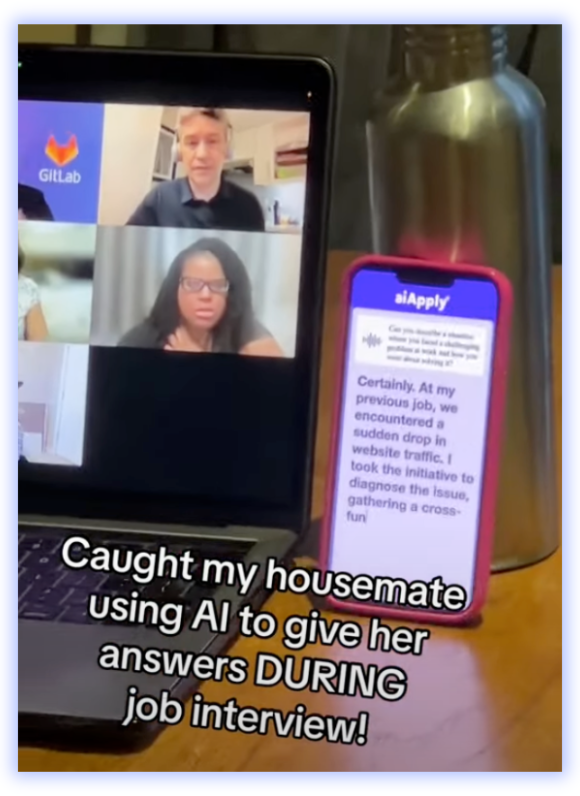
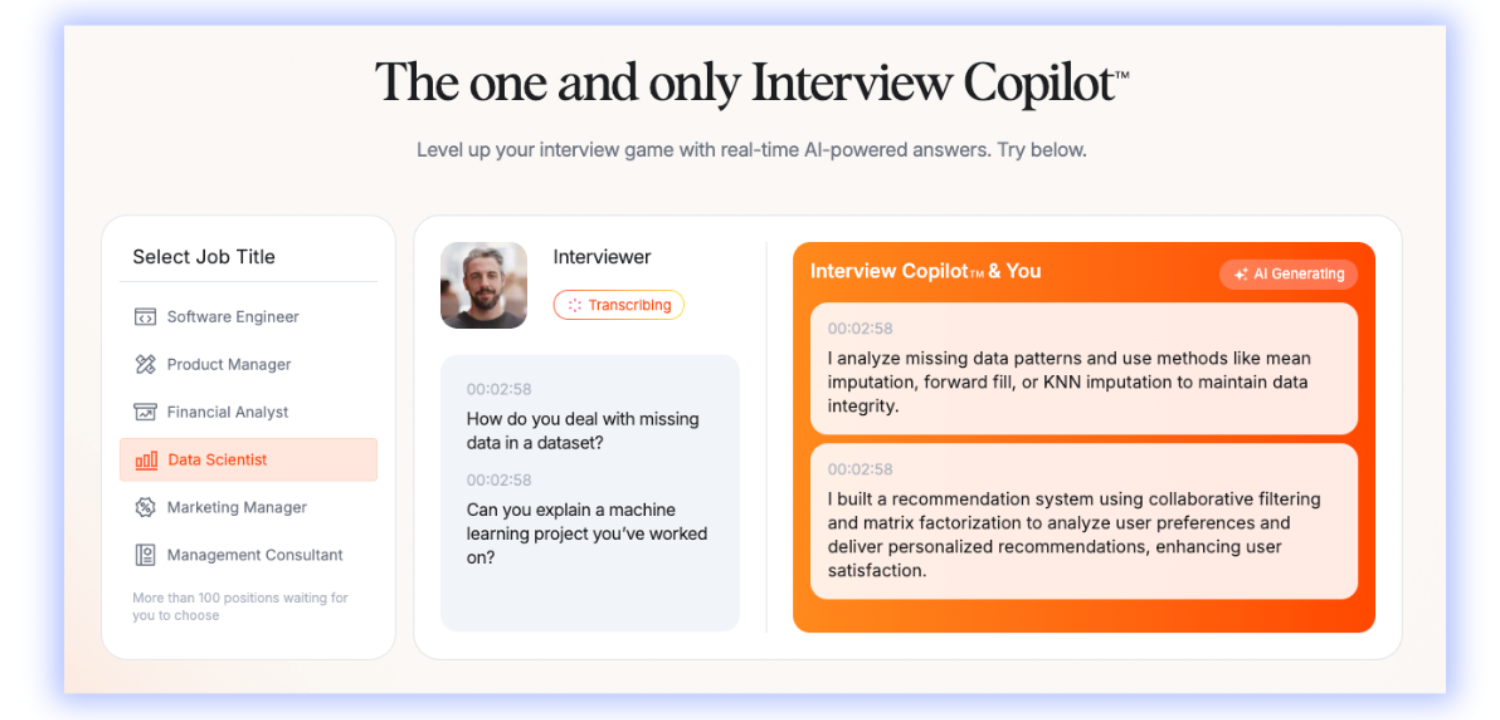
This software secretly listens to and transcribes interview questions and then spits out a word-for-word script for the candidate to recite. Candidates can even feed their resume into the tool so they have real-time AI assistance in talking about their resume experiences.
How to detect it: Watch for eyes tracking across the screen rather than at the camera, answers that arrive after a consistent 2–3 second lag, and responses that are structured and comprehensive but lack depth on personal experience specifics. Interrupt mid-answer with a follow-up question to dig deeper. Copilots handle prepared questions far better than genuine back-and-forth.
2. Deepfake Video and Face-Swap Filters
What required a specialist in 2024 now runs in real time on consumer hardware. Candidates overlay a synthetic or borrowed face onto their own, letting one person interview for another or masking a stolen identity entirely. Gartner predicts that by 2026, 30% of enterprises will no longer consider identity verification and authentication solutions reliable on their own, precisely because AI-generated deepfakes have made it so hard to tell a live face from a fake one4.
How to detect it: Ask the candidate to turn fully to profile, wave a hand in front of their face, or stand and adjust the camera. Real-time face-swaps still struggle with occlusion and sharp angles. Watch for hairline flickers, mismatched lighting, and lip-sync drift under fast speech. For high-stakes roles, use liveness detection.
3. Hire someone to take the interview
Incredibly, some candidates might hire someone else to take their video interview for them, especially if there’s no video verification. Some candidates are purchasing interviews from international firms that promise to pass screening calls for them and then hand them off when the final rounds of interviews come around.
"We recently submitted a candidate who passed both of our screening rounds and unfortunately a different candidate showed up under the same name for the client call that was not qualified for the role. The client was not very happy." - CEO/Co-founder, IT Staffing Firm
How to detect it: This one is tricky. Typically if you have other measures to detect cheating in place you will filter out a hired interviewer because they often don't have the qualifications themself and have to rely on cheating methods themself to pass your screens. You can also visually cross-reference a live recording of the interview with the candidate's LinkedIn profile photo.
4. AI-Generated Resumes and Fabricated Histories at Scale
Candidates now mass-generate tailored resumes, fake reference letters, and entire synthetic work histories. In one survey, 60% of hiring managers said they could spot an AI-generated application, but 75% failed to when actually tested7. Separately, 60% of managers report having uncovered a candidate who misrepresented their experience or qualifications6.
How to detect it: Verify employment through official company channels, not the numbers the candidate supplies. Look for thin or suspiciously uniform LinkedIn networks, gaps papered over with vague contract work, and references who can't speak to specifics.
5. Stolen and Synthetic Identities
Stolen and synthetic identities are the most serious escalation. Alex recently discovered a North Korean operative posing as someone else in a hiring pipeline. Alex successfully caught them before the candidate even made it through the first round. The problem is becoming more widespread as 31% of managers say they've interviewed a candidate later revealed to be using a fake identity, and 35% say someone other than the listed applicant has joined a virtual interview6.
How to detect it: Require government-ID verification tied to a liveness check. Watch for mismatches between stated location and network/IP signals, reluctance to appear on camera unscheduled, and equipment-shipping addresses that don't match the claimed residence. Treat "my camera's broken today" as a red flag, not an inconvenience.
6. Coding Assessment Manipulation
Take-home and timed coding tests are now routinely defeated by AI. They’re easily pasted into an LLM, auto-solved by browser extensions, or completed entirely by a proxy. It's a big reason cheating flags cluster in technical hiring. On Alex's platform, technical hiring often comes with suspected cheating rates twice as high as the average.
How to detect it: Pair every take-home with a live session where the candidate explains and extends their own code in real time. Ask why they made a choice, then ask them to change it. Genuine authors refactor on the spot; those who didn't write it stall immediately.
7. Hidden Earpieces and Off-Screen Coaching
Micro earpieces feed real-time coaching from a person or an AI listening in.
How to detect it: Watch for the delay and flat, recited cadence of someone repeating what they hear. Ask spontaneous, personal, or humor-based questions no coach can script. Sudden fluency on a hard question followed by blankness on an easy personal one is a classic pattern.
8. Voice Cloning and Modulation
Beyond simple pitch-shifting, candidates use real-time voice cloning to mask accents, disguise identity, or let a proxy speak in the candidate's established voice. This is increasingly paired with the identity fraud above.
Here’s an example of a female who modulated her voice with software to sound like a male.
How to detect it: Listen for unnatural evenness, artifacts on plosive sounds, and audio that doesn't match the room or the candidate's breathing. Ask them to laugh, react, or speak quickly: cloned and modulated voices degrade under spontaneity.
The Pattern Behind All Tactics
Every one of these tactics shares a weakness: it collapses under real, spontaneous, adaptive conversation. Scripts, copilots, proxies, and coaches all excel at the expected and fail at the unexpected. The defense isn't better detection software, it's interviews designed around genuine interaction and verified identity.
That's exactly what we're building at Alex AI. Our AI interviewer, Alex conducts adaptive, real-time conversations that probe beyond scripted answers, flags the behavioral and technical signals of cheating as they happen, and verifies that the person you're talking to is the person you'll hire.
Want to see how Alex catches these tactics live? Book a demo.
.jpg)
Our latest posts
The latest news, interviews, and resources.


Stay ahead of the crowd
Subscribe to our official company blog to get notified of exciting features, new products, and other recruiting news ahead of everyone else.